

How to Recycle in Korea: A Guide for Expats

If you are traveling in Korea or staying here long-term, you will likely find yourself wondering about this at some point.
- "Where am I supposed to throw away this plastic bottle?"
- "There's still a bit of food left in here—is this recyclable?"
- "Does an instant ramen cup go in the regular trash?"
Korea has a well-established recycling culture where waste is carefully sorted and disposed of by category.
It might seem a bit complicated at first, but once you get the hang of a few basic rules, it's really not that hard!
🇰🇷 1. How is trash categorized in Korea?
Generally speaking, waste is separated into the following categories:
- ♻️ Recyclables
- 🗑️ General waste
- 🍚 Food waste
- 🛍️ Plastic films/bags
- 💡 Separate disposal items (like spent batteries and fluorescent lights)
Keep in mind, though, that exact collection days, locations, and detailed guidelines can vary by neighborhood.
Especially if you're staying at a hotel or accommodation during your trip, it's always safest to check the disposal guidelines provided by your host or front desk first.
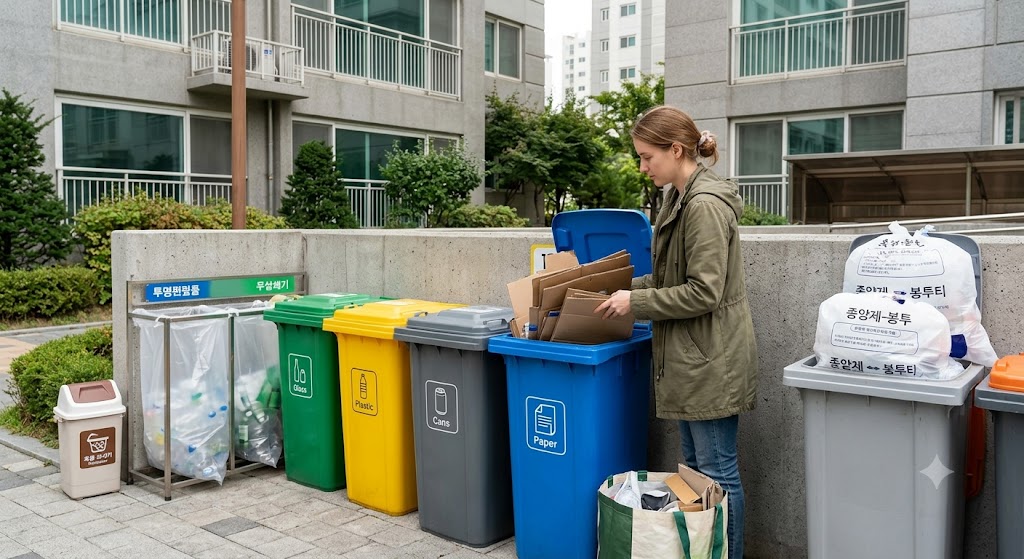
♻️ 2. Please sort your recyclables by material
When it comes to recycling, the golden rule is to separate items by their material rather than just tossing everything in together.
Newspapers, magazines, paper boxes, and cardboard are the most common types of paper. When throwing them away, make sure to:
- Remove any food residue or foreign substances
- Take off tape attached to the boxes
- Strip away plastic-coated sections
- Keep them dry and prevent them from getting wet
and prepare them accordingly.
Milk cartons and paper packaging are sometimes collected separately from regular paper, so check for local guidelines.
🥤 Plastics & PET Bottles
Make sure to completely empty out water bottles or beverage containers before tossing them. Whenever possible, follow this simple routine:
① Empty contents → ② Remove labels → ③ Crush them flat → ④ Put the cap back on
Preparing them this way makes a big difference.
In apartment complexes throughout Seoul, clear PET bottles must be kept completely separate from other plastics.
🥫 Cans & Metals
This covers things like beverage cans and food tins.
Rinse out any remaining residue and make sure they are clean before disposal.
Leaving food or drink inside can ruin the recycling process for the whole batch.
🍾 Glass Bottles
This includes drink bottles and certain food jars.
It is best to empty them out and give them a quick rinse first.
⚠️ Broken glass needs to be handled differently than regular glass bottles. Seoul city guidelines require broken glass products to be disposed of in standard regional waste bags or heavy-duty special disposal sacks.
🛍️ Plastic Bags & Wrappers
Certain flexible plastic packaging—like snack bags, ramen wrappers, and food film—can actually be recycled. Before tossing them out,
Empty out the contents → Clean off any residue → Place them in a clear or translucent bag
as the standard procedure.
Keep in mind that not all plastic wraps are recyclable.
For instance, items that are tough to recycle, such as plastic food wrap or certain multi-layered packaging materials, should go into the regular trash.
🗑️ 3. Regular Trash Goes in Official City Bags!
General household waste that cannot be recycled needs to be thrown away using standard municipal waste bags.
In Korea, you can't just use any old plastic bag for your general trash; you're required to use the official garbage bags designated by the local district office.
For example, Jung-gu in Seoul specifically instructs residents and visitors to use these official bags for general waste disposal.
🗑️ Examples of Regular Trash
- Used tissues and wet wipes
- Soiled or contaminated paper
- Multi-layered products that are difficult to recycle
- Certain rubber items
- Hard-to-recycle packaging materials
- Containers stained with food residue that can't be cleaned
TIP!
If you are thinking, “This looks recyclable, but I'm not entirely sure,” it’s safer to check the local recycling guidelines rather than just guessing and throwing it in the recycling bin.
🍚 4. Food Waste Goes Separately
This is one of the trickiest parts for international visitors in Korea.
Food waste must be separated from general trash and disposed of accordingly.
What counts as food waste: Shake off as much excess moisture as possible, then dispose of it in designated food waste bins or bags.
❌ These Are NOT Food Waste!
Not everything related to food belongs in the food waste bin.
The following items are typically classified as general trash:
- 🥚 Eggshells
- 🦀 Shells from crabs, shrimp, and other crustaceans
- 🐚 Shells from clams, oysters, and other shellfish
- 🐟 Fish bones
- 🍗 Bones from chicken, pork, beef, and other meats
- 🌰 Hard nut shells
- 🍑 Hard pits from peaches, persimmons, and similar fruits
- 🧅 Onion and garlic skins
- 🌽 Corncobs
The Seoul Metropolitan Government also classifies shellfish shells, hard fruit pits and skins, meat and fish bones, and onion peels as general trash rather than food waste.
🏨 How to Throw Away Trash at Hotels and Accommodations
This is especially important for travelers.
Disposal rules can vary depending on where you are staying, whether it's a hotel, serviced residence, or Airbnb.
Hotels
If there is a trash can in your room, you can simply use it following the hotel's in-room guidelines.
Residences & Airbnbs
Apartment complexes and serviced residences often have a designated recycling area inside the building.
In this case,
Plastics / Paper / Cans / Glass / Vinyl / General Waste
Make sure to sort your items into the corresponding bins.
💡 The Best Approach
Just ask the staff at your accommodation:
“Where should I throw away my trash?”
or
“Where is the recycling area?”
Comments0
Be the first to comment