

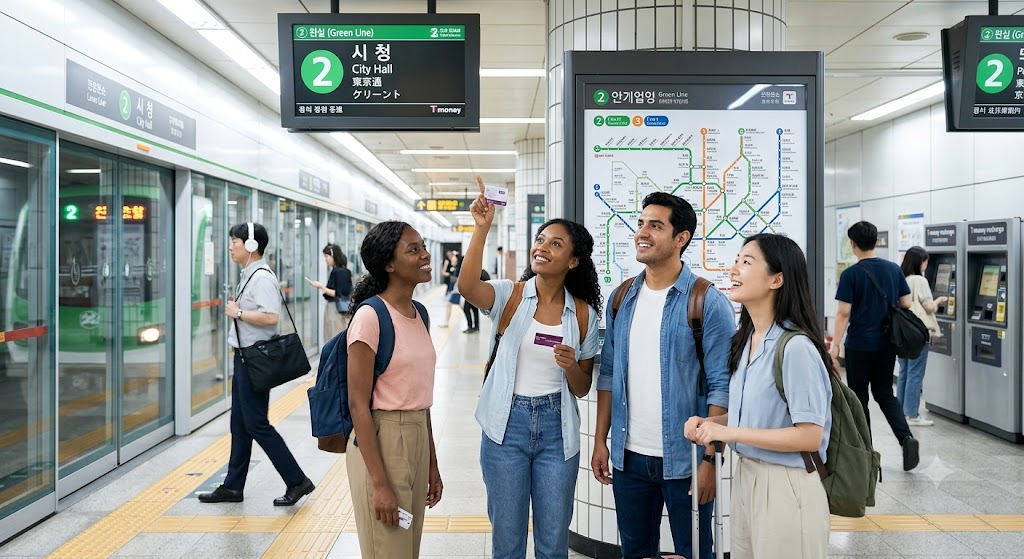
Seoul Subway Guide for Foreigners

If you are visiting Seoul for the first time, the complex subway map might feel a bit overwhelming. However, the system is very tourist-friendly with clear English signage, and once you know a few basics, getting around is actually quite straightforward.
Most major hotspots like Myeongdong, Hongdae, Gangnam, Dongdaemun, Jamsil, and Itaewon are easily accessible by subway. It is by far the best way to bypass the city traffic and arrive at your destination on time.
🚉 1. Understanding the Subway Lines
The Seoul subway network consists of multiple lines, each identified by a unique number and color.
For instance, Line 1 is dark blue, Line 2 is green, and Line 3 is orange. This color-coding makes it relatively easy to trace your route on the map.
Station names are routinely announced and displayed in both Korean and English, allowing you to easily track your location as you ride.
To make things even smoother, check your departure station, arrival station, and any transfers on a map or transit app before you head out.
💳 2. Getting a Transit Card
If you plan on riding the subway frequently during your stay, getting a rechargeable transit card is a must.
The most popular choice is the T-money card, which you can easily purchase and top up at any convenience store or subway station.
Using a transit card saves you from buying individual single-journey tickets every time; simply tap the card at the turnstile and walk right through.
If you plan to use public transportation heavily over a set period, it is worth looking into tourist passes or specialized transit cards tailored to your travel itinerary.
🎫 3. How to Ride the Subway
Once you arrive at the station, first check the number and direction of the line you need to take.
Swipe your transit card at the turnstile and head down to the platform. Since the same line can run in different directions depending on the platform, double-check the terminal station name for your destination before boarding.
When the train arrives, basic etiquette dictates that you wait for passengers to finish getting off before you step inside.
🔄 4. How to Transfer Lines
Getting around Seoul by subway often means you will need to transfer to a different line.
Once you arrive at a transfer station, just follow the signs that say "환승" or "Transfer." Some transfer corridors are quite long or split into multiple paths, so keep a close eye on the overhead directional signs.
When making a transfer, it helps tremendously to keep track of both the line number and color of your current train and your next one.
Major transfer hubs like Seoul Station, Sadang, Express Bus Terminal, and Jamsil can involve quite a bit of walking, so it is best to give yourself plenty of extra time.
📱 5. Make Your Trip Easier with Map Apps
If you are riding the Seoul subway for the first time, using a local map app is practically a must.
Just plug in your destination to see which subway station to walk to, which line to take, and where you need to transfer.
Checking which line and direction you need ahead of time will save you from wandering around the station confused.
It is also a great idea to save the addresses and subway station names of your must-visit spots before you even head out.
🚪 6. Always Double-Check Your Exit Number
Big subway stations in Seoul often have a maze of multiple exits.
Even within the same station, Exit 1 and Exit 10 can be quite far apart, so it is best to double-check the exact exit number on your map once you arrive.
This is especially helpful when heading to hotels, restaurants, or tourist spots—don't just look up the station name, but check which exit you need to use as well.
⏰ 7. Keep an eye on the last train times
When you are out sightseeing all day in Seoul, you might find yourself staying out quite late.
Since the subway doesn't run 24/7, checking the last train schedule in advance is crucial if you plan on traveling late at night.
If your journey involves a transfer, you need to check not only the last train time for your first ride, but also the schedule for your connecting line.
Missing the last train might mean you have to rely on taxis or late-night buses, so it is always smart to plan your way back if you are staying out late.
🎒 8. Essential subway etiquette to keep in mind
Being considerate of fellow passengers is a big deal on the Seoul subway.
- 🚫 Avoid loud phone conversations inside the train
- 🎧 Always use earphones when listening to music or watching videos
- 🚪 Don't block other passengers when getting on or off
- 💺 Leave priority seating open for seniors, pregnant women, and those in need
- 🎒 Wear your backpack on your front during crowded times
- 🚶 Be mindful of others and keep moving on escalators
The subway can get extremely packed during rush hours, so as a tourist, it is usually best to avoid peak commuting times if you can.
🧳 9. Traveling with large luggage or suitcases?
It is quite common to navigate the subway with heavy bags while traveling.
Elevator and escalator locations vary by station, so if you are hauling heavy luggage, it is a good idea to check where the elevators are beforehand.
Also, during peak hours, large suitcases can block the flow of traffic for other passengers, so try to travel during off-peak times and make sure not to leave your luggage blocking the aisle on the train.
If you are hauling heavy luggage from the airport to your hotel, it is worth comparing the subway with other options like the AREX airport express or airport limos.
💡 Quick Tips for Riding the Seoul Subway
The Seoul subway map might look overwhelming at first glance, but navigating it becomes a breeze once you keep four simple things in mind: the line number, line color, destination direction, and exit number.
Before you head out, look up the closest station to your destination along with your transfer points and exit numbers ahead of time to save yourself a ton of wandering around.
Grab a transit card in advance and keep a map app handy, and you will be zipping around Seoul's top spots with zero hassle.
🇰🇷 First Time Taking the Seoul Subway?
① Get a transit card → ② Look up your destination → ③ Check the line and direction → ④ Follow the transfer signs → ⑤ Find your exit number
Stick to this simple routine and even first-time visitors will find riding the subway in Seoul an absolute snap.
Mastering the subway is the ultimate travel hack for hitting up all of Seoul's hottest neighborhoods—from Myeongdong and Hongdae to Gangnam, Dongdaemun, and Jamsil—quickly and efficiently. 🚇🇰🇷
Comments0
Be the first to comment